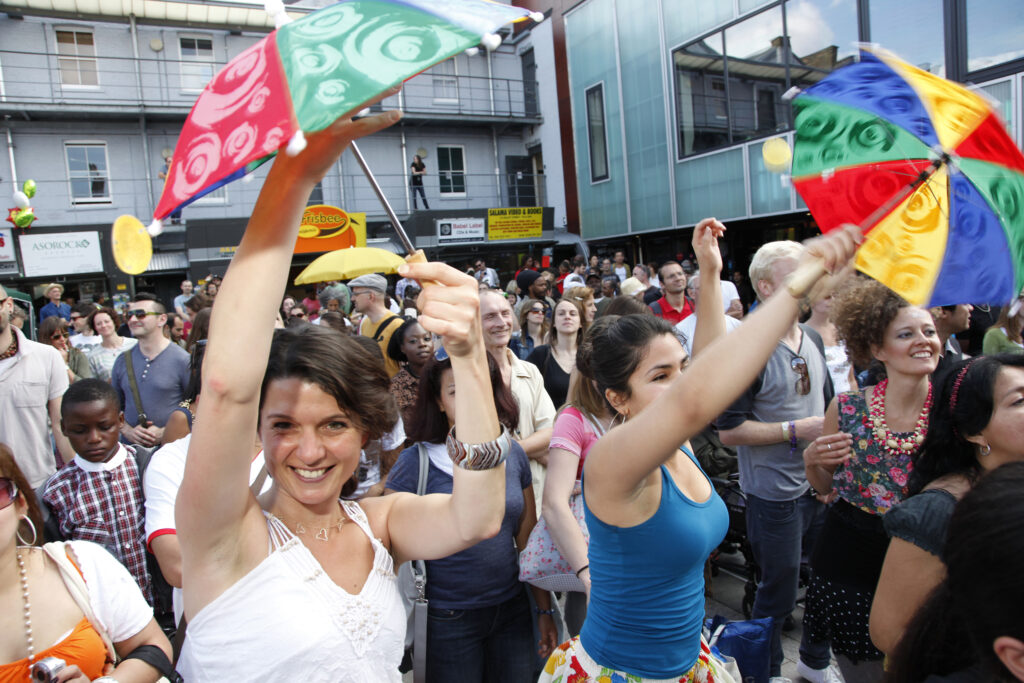
Introduction to Hackney and Dalston
Hackney is a truly global and diverse borough. Historically, Hackney has been a borough that welcomes people from around the world and inward migration dates back to the 18th and 19th centuries. In the 1950’s and 1960’s, labour shortages in the reviving post-war economy drew in migrants from the Caribbean, Cyprus, Turkey and South Asia.
The ONS estimated that Hackney’s population is around 260,000 and predicts it will grow to around 300,000 by 2050. Around 47% of the population come from Black and Global Majority groups, with the largest (21%) being Black or Black British. 36% of the population are White British.
Hackney has one the largest groups of Charedi Jewish people in Europe. They predominantly live in the north east of the borough and represent around 7% of the borough’s overall population. At least 4.5% of Hackney’s residents are Turkish or Kurdish and are mainly concentrated in the South, East and Central parts of the borough. At least 89 different languages are spoken in the borough.
Nearly four fifths of residents say that Hackney is a place where people from different backgrounds get on well together. Hackney’s diversity and multiculturalism are the main factors contributing to residents feeling proud of Hackney. In part this is a result of Hackney’s long history of immigration and welcoming people into the borough which has resulted in local neighbourhoods that are very diverse where people have an opportunity to mix and meet people from different religious and ethnic backgrounds. Many people also have personal or family experience of migration and people are welcoming to new arrivals.
Population characteristics
There are well established Caribbean, Turkish and Kurdish, Vietnamese and Orthodox Jewish communities. There are also newer communities of people from African countries and Eastern Europe.
Hackney is a relatively young borough, with over half of the population (55%) under 35 years old, and almost a third (31%) aged under 24. People aged over 55 make up 17% of the population.
According to the 2021 Census there are proportionally more women living in Hackney than men with 52.2% of the population female and 47.8% male. The proportion of males under 20 is slightly higher than females, but there are higher proportions of females in all age groups over 55 years than males.
Local urban environment
44% of Hackney residents live in social housing, provided by either the Council or a social landlord such as a housing association. The majority of social rent homes in the borough are offered by Hackney Council to households on the Council’s housing register, with applicants and tenants able to bid for homes that are available.
The population density in Hackney is approximately 36,250 residents per square mile (14,000 residents per square kilometer). This makes it one of the most densely populated areas in London, but it is also one of the greenest. With falling levels of car ownership, CO2 emissions are amongst the lowest in the UK and Hackney has 56 parks, gardens and open spaces covering 330 hectares, 15 of which have been awarded the green flag quality mark. However, Dalston has 57% less green open space than Hackney Borough as a whole (only 17.1%), no public parks and only 4.22 hectares of open space, making HCD’s Gillett Square development a vital public space for the local community.
In Hackney, 64% of children live in income-deprived households (and the rate for people over 60 is about 55%). Hackney also has 16% of neighbourhoods classed as highly deprived.
Hackney is an area of growing economic opportunity as a result of the increased focus on East London as an area of growth and development for London and the UK. This growth sits alongside significant deprivation. Some local people continue to face persistent inequalities and are disproportionately affected by child poverty, worklessness and welfare dependency.
Regeneration and Housing
Dalston is Hackney’s largest town centre.
It’s known for its creative industries, cultural organisations, night-time economy and mix of communities.
The area has a strong identity, defined by its:
- high-quality architecture
- built heritage
- nighttime venues around Gillett Square
- shops along Kingsland High Street
- long-standing street market at Ridley Road
Over the last 15 years, Dalston has changed as it has become a more popular place to live, work and visit, a hub for creative industries and cultural organisations, and a destination for entertainment and nightlife.
There are 564 registered social housing properties in Dalston out a total of 3,999.
There are fewer socially rented properties in Dalston Ward compared to the borough average and of those very few are rented from the local authority.
Dalston Ward has more private renters than the borough average and more than twice the national average.
Crime
Dalston has the 2nd highest crime rate of 21 wards in Hackney district and the 102nd highest crime rate ward of 7,543 wards in England and Wales. Across the region (London), it has the 30th highest crime rate of 703 wards.
The overall crime rate in Dalston in the last 12 months was 300.6 per 1,000 residents and was 97.4% higher than the Hackney district average (152.3 per 1,000 residents). In the last 12 months, Dalston’s most reported crimes were Anti-social behaviour with 618 offences recorded. The least common crime was Other crime with 20 cases , up 25.0% compared to 2025. The fastest-growing crime category was Possession of weapons ( 31.6% YoY). The sharpest decline was Criminal damage and arson ( -26.7% YoY).
Violent crimes totalled 881 (≈ 87.4 per 1,000 residents). Year-over-year these were rising ( 5.0% ). Over the last decade, overall crime has falling ( -40.9% comparing early vs recent averages) .
In the Dalston ward, the main local crime hotspot is near Shopping Area. Police recorded 371 crimes here, including 144 violent or public-order offences. All of these hotspots lie within roughly 0.3 miles.
Employment
In Hackney, the employment rate was 81.5% for ages 16 to 64 in the year ending December 2023. Unemployment was 3.8% for ages 16+ in the same period, and economic inactivity was 13.8% for ages 16 to 64.
Business and Enterprise
In Hackney, the Hackney Business Network has a community of over 5,000 local businesses and offers dedicated guidance and support.
There just over 21,000 businesses registered in Hackney. The majority are 1 person or micro buisness.